
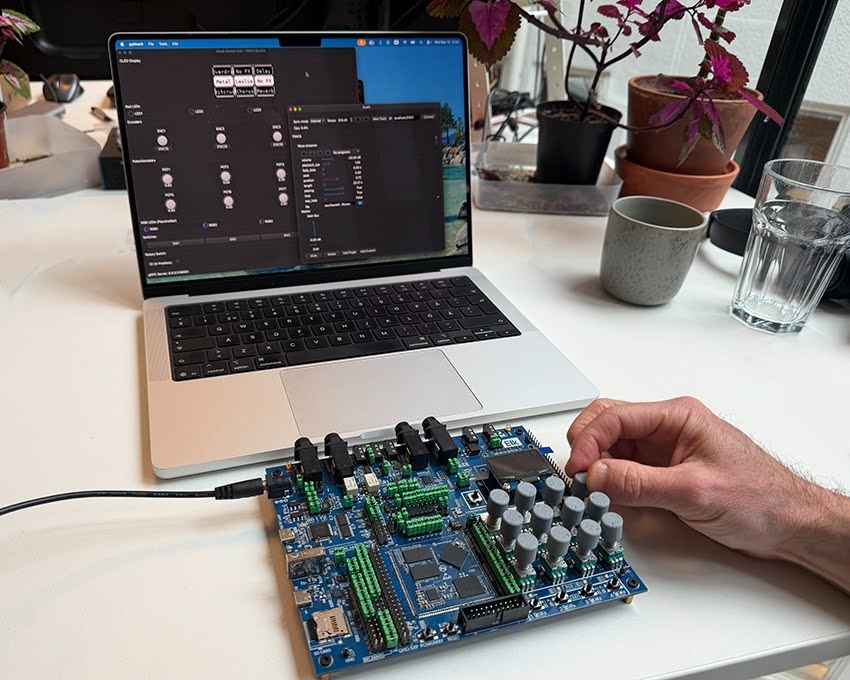
Developing for embedded audio hardware has traditionally been a slow and complex process. Long iteration cycles, hardware constraints, and integration overhead have often made rapid prototyping difficult. In our recent work with the Elk Stomp dev kit, we explored how much this has changed.
From idea to hardware in less than a day
As part of an internal project, the Jackpot pedal, we vibe-coded a couple of VST plugins and got them running on embedded hardware in less than a day.
This kind of turnaround would have been difficult to achieve not long ago. What stood out to us was not just that it worked, but how straightforward the process felt.
Instead of dealing with complex setups and long feedback loops, the workflow felt much closer to standard software development:
- Write plugin code
- Deploy to hardware
- Iterate quickly
This shift opens up new possibilities for developers and companies working on audio products. Hardware is no longer a bottleneck in the same way, it can be part of a fast, iterative development process.
Embedded audio development is changing
The ability to run plugin-based workflows directly on embedded systems changes how products can be built.
Rather than building everything from scratch at a low level, developers can:
- Reuse familiar plugin architectures
- Prototype faster
- Iterate on sound and behavior in real time
This lowers the barrier to entry for creating hardware products such as guitar pedals, effects units, and other audio devices.
Use cases
We’re already seeing this approach being useful for:
- Guitar pedals and effects units
- Plugin-based embedded audio devices
- Rapid prototyping of audio products
- Testing DSP ideas directly on hardware
Getting started
If you’re exploring building your own audio hardware or plugin-based product, tools like the Elk Stomp dev kit are designed to help you move quickly from idea to working prototype.